-
Living the ‘dream’: life in a big box

There’s an old song which captures it rather well — the essence of the middle-class dream, as it were. The details might differ – note that Seeger’s little boxes are the BIG boxes of today, and they’re not always on the hillside either. I think of the sprawling, new-build suburbs. I spent three months working in Auckland once. I rented a spare room in what felt like a palatial house occupied by a family of four. Who the architect or property developer had in mind when they built it, I don’t know. That it was far beyond what a family of four needed was patently obvious. This house, as with many of these houses, presumably came at such a price that having a boarder was something of a necessity. AirBnB’s have a similar function when it comes to paying for such places. Again, I have stayed in some of these rooms when I needed a place in the city.
I have come to know what to expect on this front. In my personal experience, the occupants of these houses are often fairly new migrants. When I knock on the door – or, as is more likely these days, when I interact with whatever technological entry system might be in place – I know exactly what to expect. These migrant families are the decent, hardworking, polite kinds of people that tend to be model families. I sometimes wonder if they come to live in such places through deliberate and conscious choice, or that it is simply because this is the housing stock that is available to them, and then they find a way to make it work.
The noticeable thing about these suburbs full of sprawling houses is that they seem to be typified by a lack of any culture at all. For sure, inside the houses there might be something that points to a culture of origin, but even that isn’t always the case. Many feel more like edifices to a cultural no-man’s land – monuments to a lifestyle where the wide-screen TV takes up the better part of a wall, where the furniture is spotless, and the dog (if there is one) is regularly taken to the groomer and does not have a hair out of place. Such dogs don’t smell of dog, they smell of perfume.
The development and uptake of such housing and lifestyles strike me as being something akin to the “American Dream”. Even far away from America, the basic idea is the same: hard work and prosperity go hand in hand. Together, they necessarily result in a certain level of outward affluence. The house must be large, spotless and fashioned with all the latest conveniences. Ideally it needs to have space around it. The streets must be smooth. There must be plenty of room for cars. Then there are the minor accessories that sometimes come with such houses – the cushions or canvases emblazoned with words like: “Live, laugh, dream”, “Hope”, “Family” “Love”. They are sprinkled around like so many little reminders. Now, I am not suggesting that it isn’t possible to do or find those things in a palatial house within a sprawling suburb. But the positive values being promoted don’t require that kind of lifestyle in order for them to flourish. There is something vaguely ironic about having these words splashed around the interior of an immaculate, corporate-consumer castle.
Walking in these kinds of suburbs, I try to imagine what it was like before there were any palatial houses at all – when the land unfolded as acres of rolling harakeke (‘flax’) swamp, with the birds wading and squawking and flitting about, the hum of insects and a warm sun. It is still possible to find it in places. Even the most sprawling of suburbs generally has a park or two where it is possible to walk and visualise what it would have been like before the strange human tendency to build large, tacky boxes all over the place took hold. There is a sharp contrast between the natural beauty of the landscape, and the desire to clutter it up with sprawling suburbia –a suburbia resplendent with large shopping malls, cinemas and car parks.
Seeger’s song can also be referring to state housing. This is perhaps a different idea altogether – that of having large numbers of identical-looking houses built to the same design, as a low-cost means of meeting public housing needs at scale. I am not sure that the sprawling suburbs I have described above are at all the same thing. Those kinds of suburbs feel more like a physical testament to values of growth and material consumption. There might be some who say that this is simply what modern building standards demand — that these large, over-the-top boxes are in fact the minimum standards of a family house in today’s world. To which I would say: are we just slaves to these standards? Whose interests do they serve?
That these places seem to have high numbers of relatively new migrants may just be a reflection of the fact that the sub-set of those living there who rent out their spare rooms are those who are more financially constrained, and that this may be something more common amongst the new immigrant population than those who are more established. It could just be that migrants are more open to sharing their homes with visitors. Maybe it reflects a desire to move to a country where it is possible to live the suburban dream to the fullest. Or it may be that those who have lived in those areas for longer simply refuse to pay the ridiculously high prices that landlords and property developers tend to demand, while new migrants may be more willing to work long hours to pay for this ‘dream’. While these high rents are exploitative, a line-up of willing, middle-class immigrants will ensure they can stay that way.
Seeger’s song touches on the typical life stages of those living in the “ticky, tacky boxes”: first school, then university and finally some kind of professional career. Of course there is value in these things, just as there is value in thoughtful housing development. But, if they are simply a means of living a mindless ideal of consumer-culture, then it would seem nothing more than a way of reproducing the same system for generations to come, complete with all its inequalities and wastefulness.
A final point is the extent to which any of this is self-chosen. Seeger’s lyrics suggest that it is imposed from outside – that “they all got put in boxes” whether they liked it or not. To me this is an interesting consideration. How much can any of us really choose our housing and lifestyle? There is this sense that we are limited to what there is – we might have in mind an ideal kind of house that would be just right for us. Maybe it’s small, simple, well-insulated, and energy efficient. However, many factors are likely to constrain our choices. These factors include everything from affordability and availability, to land zoning, building standards, and cultural ideas of the ‘normal’ house. If we refuse to keep paying into a culture that celebrates a very large and tacky box at the centre of its housing ‘dream’, then we might just find ourselves living at the margins of that society.
Image Credit: A.I.
-
The Illusion of Military Necessity: A Critical Perspective
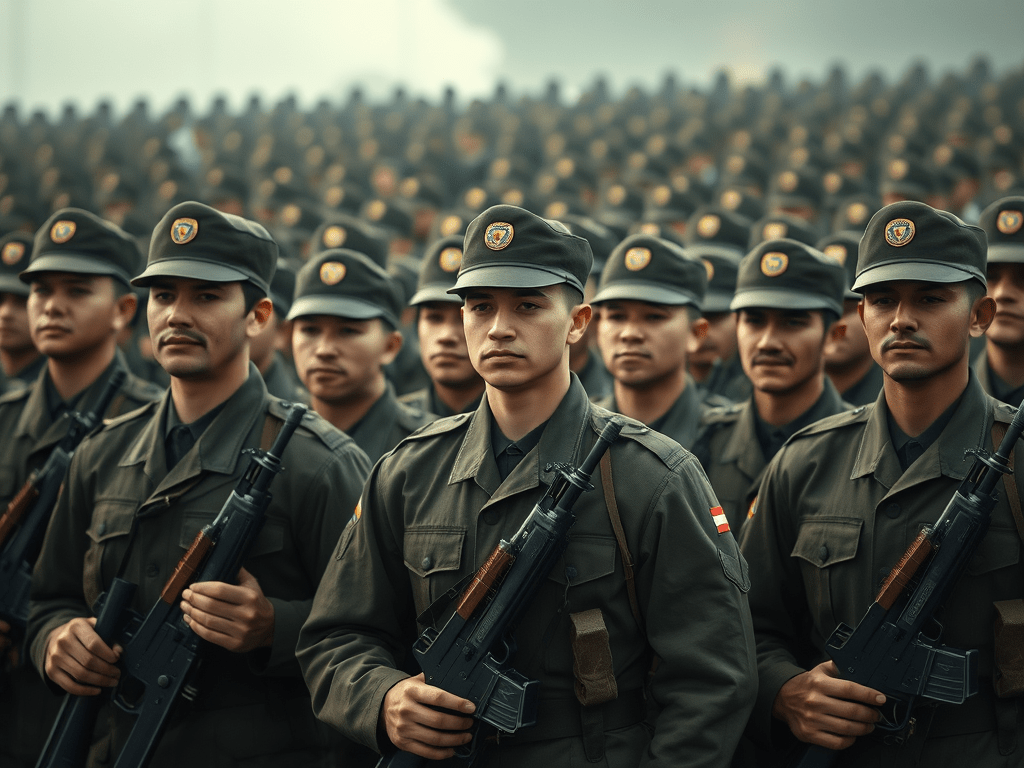
The photos are all much the same, and there seem to be a lot of them. Rows of — predominantly male – troops. Unsmiling faces aligned in the same direction. Firearms locked into symmetrical rows. The same haircuts. The same uniforms. Minor differences are to be found in the sewn-on country flags and maybe the type of firearm. The military. I look at these images and am filled with an overwhelming sense of dismal futility. Sometimes I wonder if I’m the only one who has this feeling. There’s news of more military investment coming from all quarters now. New munitions factories are opening in parts of Europe. There’s even a sense that some feel it’s a productive and unifying endeavour to rally around investing in tanks and armaments.
I wonder dully what my paternal grandfather would make of it. He, and many others of his generation, probably thought that in fighting for the duration of WW2 they were effectively guaranteeing it wouldn’t happen again: that others wouldn’t have to; that all of the mess and chaos would somehow be worth it. Even if their own lives were never going to be the same again, it would stop with them. It was a sacrifice, they thought, to ensure that Europe would be free; that the world would learn and move on and never resort to this madness again. On returning home in 1945, my grandfather’s conviction that “Europe is rotten” was firmly held. The family would move away, as many did at the time, for a new start a world away.
The other side of the family lived under occupation. Without knowing the details, I would guess the experience shaped outlook and thinking in fundamental ways. The sense that persecution could be anywhere – that neighbours might disappear, ‘they’ might come for you, and even if ‘they’ didn’t – you’d better be on your guard because there was no guaranteeing anything. Threat was the norm. Food was to be rationed. And anything that might be of some use should be kept, just in case. Even tulip bulbs might take on a new life. My family’s experience was by no means unique. One could say they were fortunate – certainly a lot more fortunate than many others.
‘The Military’, then. Back in June I received an email bearing these two words in its ominous subject line. The preamble of the attached newsletter starts like this:
“International humanitarian law (IHL) represents a balancing of priorities that have often been seen as being in tension: military necessity, on the one hand, and considerations of humanity, on the other. Inherent in this balancing act is the idea that military necessity and humanitarian imperatives are equally valid priorities that can be accommodated under the same legal framework to achieve related goals, allowing the military to fight effectively while avoiding needless suffering and destruction.”
–IRRC Vol. 107, No.928: The Military
As is typical of academic language – “a balancing of priorities that have often been seen as being in tension” – it is careful to tread very lightly and hedge its bets at every turn. It does not say, as some might, that trying to balance ‘military necessity’ (whatever that might be) and ‘humanity’ while ‘avoiding needless suffering and destruction’ and ‘allowing the military to fight effectively’ represents a complete clutter-fuck of competing priorities that are difficult, if not impossible, to reconcile. And as is typical of legal language, the terms tend to be slippery. Slippery, and superficially persuasive. What sounds good on paper may be quite different on the ground. I learned this early on through terms like ‘reasonable force’ and ‘restraint’. What is ‘reasonable’ and what constitutes ‘restraint’ is very much up to individual interpretation. To a lawyer sitting in their office with a view to the ducks floating on the pond outside, ‘reasonable force’ and ‘restraint’ are likely to be something inherently reasonable, moderate and well-intentioned. I’m guessing they might add something like ‘as a last resort’ or ‘as a preventative of greater harm’ if pressed to define the terms. To someone working in a detention centre, it could simply mean something they use in order to get their job done in a reasonable length of time. And if that means a bit of common assault or manhandling to get the job done, then to them that’s ‘reasonable force’ and ‘restraint’.
When we look at conflict, the reality might not be all that different. If a cranky little dictator decides he wants to expand his empire just that little bit further south, then there’s ‘military necessity’ as far as he’s concerned. Oh, but it’s illegal to resort to force in such a way, the lawyers and scholars might say. Jus ad bellum or jus in bello — the Latin terms, as well as the distinctions between imperial ambitions of territorial expansion or legitimate self-defence, don’t seem to matter a great deal in practice. And what’s more, reality doesn’t wait for the law. It bowls ahead and flattens a few more towns before anyone can say ‘IHL’. I suspect there are those who might say that even in the midst of these flagrant violations, the fact there is this ‘body of law’ means that there is a mechanism for accountability. Ha. The world could be waiting a very long time for every civilian death to be accounted for, for the destruction of every civilian building to be noted and remedied, for all the atrocities and violations to be painstakingly documented in courts of law, and for every victim to be fairly compensated as is their ‘right’. Again, experience would suggest that finite resources, limited political will and competing priorities will dictate that only the worst and most egregious cases are heard. As for the rest, well. Maybe they can take comfort in the fact that even though there’s no justice for them, there’s still this beautiful theoretical possibility and it’s called ‘IHL’.
It seems there is still this idea – and it may be closer to a delusion now — that somehow something like IHL and other paper-based rules and treaties are this gentlemanly thing that exists out there, in spite of the flagrant violations in all directions. Some would argue that it is still better than nothing, and maybe they hope that the doctrine of being a ‘proper gentleman’ in conducting warfare will one day prevail. This is despite plenty of evidence to the contrary suggesting that the likes of Putin and Netanyahu have no interest in being proper gentlemen, and are unlikely to suddenly be born-again in that regard. Maybe there is a sense that if the average soldier can be taught to respect and internalise IHL, then that’s something to be celebrated, never mind what the leader of his or her country might have in mind regarding total domination or wanton destruction.
I do not wish to go into the contents of that newsletter I received back in June. Suffice to say that after the initial preamble, the articles within largely seemed to glide effortlessly past the elephant in the room, broadly the elephant outlined above, to focus on various aspects of military development and practice. At a time like this, these feel like little more than distractions and diversions from the very large elephant that is currently lumbering about, looking at the next thing it might charge into. The newsletter describes its content as “topics of interest to both the humanitarian and military communities”, as if somehow these are two cosy little camps with their respective members gathering about the campfire to share interesting stories, both of them with equally valid, reasonable and worthy causes.
I think we need to be clear. Arguably there is no such thing as ‘military necessity’. Rather than blithely skipping ahead and looking at all these seemingly interesting side issues and the ramifications of various technological developments, maybe it’s necessary to take a step back and look at what exactly the options are. Parading the troops about, investing in arms, building munitions factories and focusing on gathering tanks and drones is one option. It is not the only option. And it is not necessary in the same way that humanitarian considerations are necessary. Without the basics of life, people die. Without an almost automatic recourse to violence and preparing for it, we have the possibility to think through what other options might be available. We can remember the Second World War, and rather than concluding that the answer is still the same as it ever was, we could think about what large-scale alternatives might actually look like. Impossible? Surely no more so than trying to reconcile the deadly consequences of resorting to war.
Image and Title Credit: AI
-
On IHL: A poem
We’re still going to kill each other,
But we’ll be civil about it, see.
Here’s my side and this land, and me,
And there’s your side, the other, and thee.
We’ve all heard the saying “thou shalt not kill”
But when it’s called War, there’s rules, and we’re gentlemen still.
Some of yours’ll die, and some of ours, horribly too,
But we’ll take care to ensure collateral is few
And that it isn’t for nothing. The collateral must be
Strictly proportionate and necessary
In order to meet our objectives. Our military ends.
It is possible the collateral may increase a bit
As our objectives change and evolve.
Objectives do that, especially military ones.
The rules specify that some things are valid targets,
And others are not.
While our objective might be to crush you, if not totally then completely,
We must remind ourselves not to crush your hospitals,
Your schools, your churches, your homes –
Oh, and your civilians. Yes. Your civilians.
They do tend to get in the way a bit.
We haven’t entirely worked out a way to avoid crushing them too.
The rules say they must be spared. If possible. Does make it tricky, doesn’t it?
Well, as we said right at the start – we’re still going to kill each other.
To rule, or not to rule? That is the question.
-
Sudan: victim of too many crises?

“There should not be a competition between crises. But unfortunately we’re seeing with everything going on in the world, other conflicts, other humanitarian crises and other things making headlines, that unfortunately Sudan is – I wouldn’t even call it forgotten – it’s ignored.” — Leni Kinzli
Kinzli is right. Sudan is ignored. If we go by the numbers, 30 million people in need of humanitarian assistance — that’s roughly two thirds of the population (ACAPS, 2025), 9 million displaced and 3.7 million acutely malnourished children (Goldhagen et al, 2024), then Sudan should be a lot more prominent in the media than it is. According to Oxfam, it is the world’s largest humanitarian crisis. It should be making the headlines in ways that it isn’t. It should be up there alongside Ukraine and Gaza, yet it isn’t. When I read about Zamzam, I wondered why news of what happened there didn’t register back in April. Other things did. Somehow Zamzam escaped notice. Sudan wasn’t on the radar – or at least, not as prominently as it might have been.
Two things seem clear at this point: one is that media attention and press coverage do not necessarily converge according to numbers of people affected, or areas of greatest need. This reminds me of a lecturer I had at university, asking why most of us in a graduate zoology class were fixated on studying large, visually dominant vertebrates, when the most numerous species in the world were insects. Why, indeed? He called it species bias. The same could be said for geographical bias in terms of global attention and response to crises.
Maybe it’s human psychology to pay attention to things that are flashy and attention grabbing, or to focus our efforts on places that are felt to be like us, close to us, or somehow connected. How a crisis develops can have an impact too: the perceived level of injustice, or the suddenness of onset. Conflicts that are slow to develop, or long-standing, might garner less coverage than flashpoint disasters. A political element, such as the UK’s relationship with the United Arab Emirates outlined here in the case of Sudan, may be at play. Whatever the reasons, it would seem that the collective psyche should be on guard against this tendency to pay selective attention – and that moving towards analysis and investment based on numbers and need is a necessary correction.
Second is the fact that breaking news columns tend to feature an assortment of useless fluff amongst the range of grim realities. Competing with news of genocides and global conflicts, are stories about Taylor Swift’s new love interest, or some development in the personal life of Meghan Markle. For one thing, we only have so much time and attention. Weeding the news is time-consuming. It’s distracting. And it seems to suggest that the love interests of a musician are somehow equally deserving of our collective attention as life-and-death humanitarian emergencies.
Reflecting on those last two words humanitarian emergencies, it is possible to take a more philosophical approach. Calhoun (2010) does just that in an article titled ‘The idea of Emergency: Humanitarian Action and Global (Dis) Order.’ He describes what he calls ‘the emergency imaginary’ – a way of thinking that construes these as large, unpredictable events emerging out of nowhere, rather than the result of long-term political, economic, environmental and social factors coming to a head – a therefore predictable phenomenon. Coupled with that is the immediacy of news of such events, and how they are portrayed:
“This sense of suddenness and unpredictability is reinforced by the media, especially by television. The continuous stream of reporting on gradually worsening conditions is minimal and usually consigned to the back pages of newspapers and specialist magazines. It doesn’t make the cut for headlines—let alone half-hour broadcast news programs. So when violence or vast numbers of people lining up at feeding stations do break through to garner airtime, they seem to have come almost from nowhere.”
Again, I am reminded of a university lecturer, a different one this time, who predicted with an uncanny degree of accuracy the potential impacts of an earthquake occurring in a particular place. Five years later, the predictions came true – not through the major geological fault line he’d been referring to, but an altogether smaller and lesser known one. The combination of building in a particular area, a range of older, unreinforced buildings, and the human tendency to ignore low-likelihood, high-impact scenarios and fail to plan for them, combined with a natural event outside of anyone’s control. It had all the hallmarks of an emergency: unpredictable, devastating — yet very predictable in what the consequences might be if one had cared to look ahead and listen.
In light of this tendency to focus on emergencies, Calhoun describes who, or what, he believes ‘humanitarian’ has come to signify:
“The term “humanitarian” now is reserved for actions free from longer-term political or economic entanglements, actions deemed right in themselves, the necessary moral response to emergencies. It is something good to do without waiting for progress, even if you have doubts that progress will ever come. The emergency has become definitive because it is understood to pose immediate moral demands that override other considerations”
“It is the focus on immediate response suggested by the emergency imaginary, with its emphasis on apparently sudden, unpredictable, and short-term explosions of suffering. And it is sustained by the experience—or at least the hope—of altruistic work, of work embedded in direct moral purpose.”
Something good to do; the hope of altruistic work…with direct moral purpose. And, crucially, something good to do and by implication to feel good about, while wider circumstances, root causes and contributing factors are not addressed. It is not hard to see parallels, or similar ways of thinking, that take place in other settings. Take criminal offending and the justice system, for example. An offender is brought to trial. The offender is duly convicted and sent to jail. This too, is a reaction to an emergency of sorts: a moral and legal reaction to a criminal act. And while a judge might mention mitigating factors like the offender’s personal circumstances, the wider societal systems, and what might be a wide range of factors that lead to criminal offending, are left unaddressed. The emergency – or the offender – having been dealt with, life goes on until the next case comes along: another urgent response, another prison sentence or intervention, and maybe a sense that justice and morality has been served once again. Yet the long-term problems, the structural inequalities and issues that plague a society may persist, resulting in the same preventable things happening again.
Calhoun summarises this way of thinking as follows: “Emergency” thus is a way of grasping problematic events, a way of imagining them that emphasizes their apparent unpredictability, abnormality, and brevity and that carries the corollary that response—intervention—is necessary.’
We could look at Calhoun’s article about emergencies and point to the fact that these thoughts were written 15 years ago. Has the world moved on? From looking at the media today, it would seem that it hasn’t. We are still in a state of panning attention from one breaking emergency to the next, with what seems to be an ever-growing demand on our collective attention, and our potential for action. Attention is not necessarily given according to need, meaning that certain countries or regions, such as Sudan, are ignored and effectively left behind. The tendency to think in terms of emergency and urgent response, largely ignores root causes and the predictable, cumulative effects that build-up to create the next breaking ‘emergency’. The last word, too, shall go to Calhoun:
But transforming the global order—say, by making it more egalitarian as a way of limiting future suffering—is not on the manager’s agenda.
Reference: Calhoun, C. (2010). The idea of emergency: Humanitarian action and global (dis) order. Contemporary states of emergency: The politics of military and humanitarian interventions, 29-58.
Image Credit: AI
-
Gaza, war and the cost of inaction
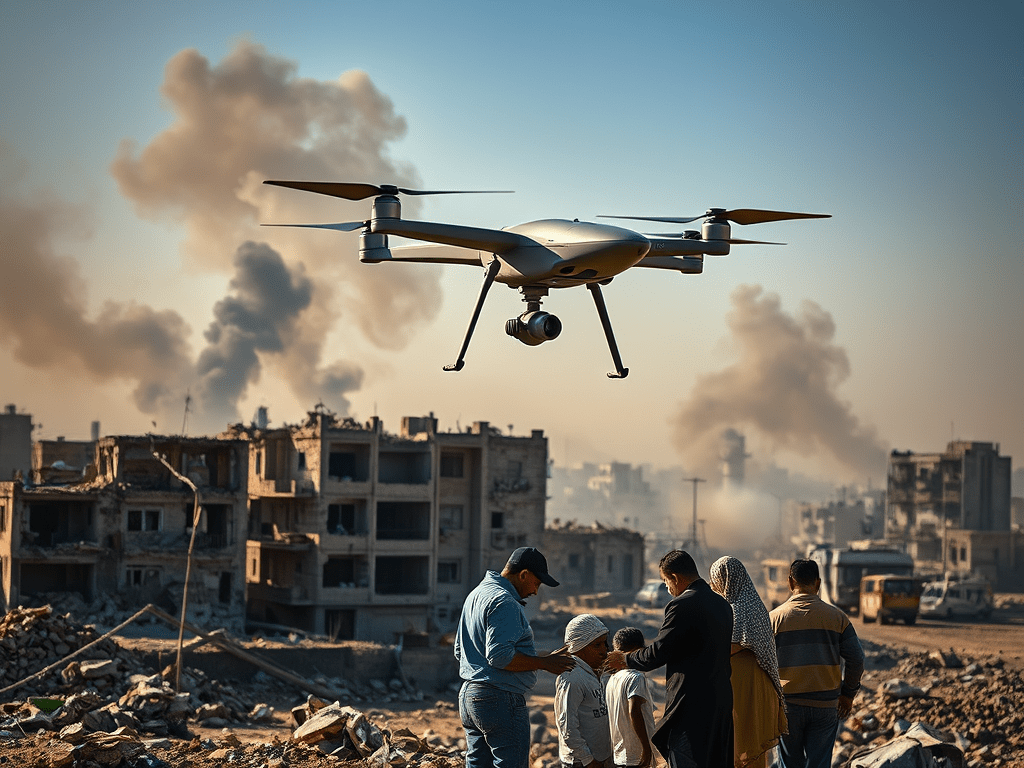
1 Shahed drone: between 20 – 50,000 USD
1 Patriot air defence missile system: 4 million USD
Estimated cost of reconstruction in Gaza: 50 billion+
Estimated reconstruction costs in Ukraine: 524 billion
Climate change adaptation costs : USD 140 billion to 300 billion per annum by 2030
What do these figures illustrate? That war itself is very costly, cleaning up the aftermath may well be even costlier, and to put it all in perspective: there are ample costs as it is. The cost of climate change adaptation, for example. They are costs that require cooperation, not conflict. And this is only in terms of money and financial cost. Add to that the costs of displacement: again, financial, but also the psychological burden. Factor in the disruption to lives and livelihoods, intergenerational trauma, human rights violations, grief and loss: the costs are phenomenal. Meanwhile, valuable time and resources for combating climate change are being diverted towards conflicts. Even thoughts and intellectual effort are directed towards military ends, rather than towards solving shared problems.
Many of the places currently facing conflict or war, were already in a precarious situation, with poverty, environmental constraints and climate change. Take Sudan, for example:
BBC: Sudan War – https://www.bbc.com/news/articles/cjel2nn22z9o
“Its 46 million people were living on an average annual income of $750 (£600) a head in 2022. The conflict has made things much worse. Last year, Sudan’s finance minister said state revenues had shrunk by 80%.”
Or Gaza:
BBC: Gaza War – https://www.bbc.com/news/articles/ckglpk9xjewo
“The UN says water shortages in Gaza are worsening due to the lack of fuel and spare parts for desalination, pumping and sanitation facilities, as well as insecurity and inaccessibility due to Israeli military operations against Hamas and evacuation orders. As a result, many people are receiving less than the emergency standard of 15 litres per day, amounting to what the UN calls ‘a human-made drought crisis’. ”
The current situation in Gaza is abundantly clear: starvation and famine. Food is not getting through. When it does, desperate civilians are being killed trying to get to it. In the face of all this, what do we do? Trying to ensure food trucks get into Gaza is proving difficult enough. Is it still worth donating money in the hope this somehow translates into aid on the ground reaching those that need it? Does pressuring governments make any difference, when the views and statements of those governments seem like little more than dust in the wind?
The Gaza conflict is approaching the two-year mark. What started with horror at the actions of Hamas, turned to horror at the actions of the Israeli Defence Force. To provide context, the figures are around 1200 people killed by Hamas in the October 7th attack, with 251 taken hostage, and 58,895 people killed by Israel at the time this article was published. Israel’s right to defend, fails to hold up when compared to the numbers of civilians killed in Gaza.
There has been a certain level of intellectual ambivalence with regards to this particular conflict. We can look at how the war started, and see that this was a clear attack on Israel. Even today, Israeli hostages remain in Gaza, at least twenty of whom are believed to be alive. Israel has vowed they won’t stop until they have rid Gaza of Hamas. As an individual it feels hard to hold a complete view on the situation. The political realities are complex, and they span long lengths of time well before the events of 7th October 2023. There are alliances of traditional allies that have influenced the timing and nature of political responses, and indeed the reluctance of some states to condemn Israel’s actions. Not only is it hard to grasp the politics just by reading about it, but there are also questions over motivations and views, and whether the views presented by politicians, academics or professionals in Western media are representative of significant parts of their respective populations, or not.
Finally, there is the familiar back and forth that has come to characterise other situations of conflict around the world. One state, being accused of something, quickly denies or disputes it, saying it’s not the truth. With restrictions on media reporting, such as is currently the case in Gaza, this becomes impossible to verify or fact check for the average person. Further complicating matters is the fact that most reported figures from Gaza are courtesy of ‘The Hamas-run Health Ministry’. How much trust one can place in those figures, and any concerns about bias, have to be balanced by the fact that when it is the only form of reporting of civilian casualties, it would be unwise to dismiss them out of hand. How much trust can be placed in any of Gaza’s institutions feels like a similar balancing act. But while Hamas might run Gaza, how much support do they really command?
Potential resolutions or ways forward that have been discussed include the release of Israeli hostages held in Gaza as a starting point, an arms embargo on Israel, the use of sanctions, and recognition of a Palestinian state and a two-state solution. These are mostly high-level responses involving long-term efforts and negotiations. The immediate issue that won’t wait for any of that to happen, or not happen, is the starving civilians in Gaza. Standing in a crushing crowd with a tin basin in hand to collect food, keeping the sun away with it as one continues to wait, is not something anyone should have to endure. Children carrying jerry cans of water, if they’re able to find any, or doubled up under crippling loads, are not something the world should tolerate as images of childhood. People starving to death in the 21st Century is not something the world must accept. The solutions to immediate humanitarian necessities such as these must be considered an immediate priority, separate to discussions around what the long-term future might look like. It is an indictment on our joint humanity if there isn’t an end to this – and soon.
Image Credit: AI
-
The Consequences of Unaddressed Grievances
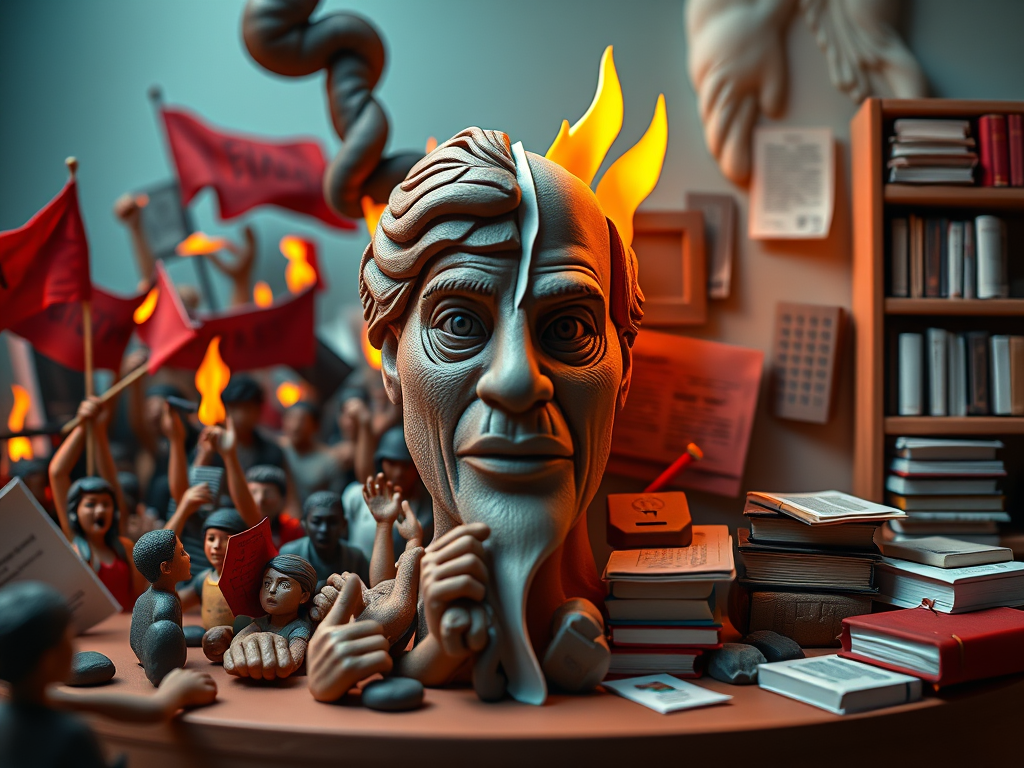
What happens when valid grievances are left unaddressed? I type this into Google Scholar. Then I type it into Meta AI. Of course, academically and philosophically, there is a great deal of ‘unpacking’ to do of this search command. Questions like: What is valid? What constitutes a grievance? Do grievances exist? How do we legally define a grievance? When is a grievance admissible? I could probably continue with this list of questions all day, but I won’t. What I am looking for is a humanistic overview. Ironically, it is AI that provides it.
This is not the time when I want to read sentences like “this conceptual study evaluated the available literature…” Great. Research, evidence, analysis – all very commendable. But this is the 21st Century, humans have feelings, buffoons get elected to public office, and Meta AI might just understand what is meant by the term ‘grievance’ better than anything I find on Google Scholar. Right now, I do not want to read an academic study about the application of grievance process in employment contexts, and what it signifies for employers and employees more generally. It’s not that I don’t care, I do. I appreciate that someone has gone to the effort of analysing many cases, and then drawing their carefully considered conclusions for what it means and how it might be relevant. This is the work of years – and not just in terms of one particular study. The whole academic and scholarly community is built on the idea of slow, methodical, incremental steps. Painstaking care and rigorous analysis are what counts above all. A sense of urgency or emotion doesn’t enter into it. In contrast, there is the world at large: chaotic, fast, increasingly unpredictable, moving from one soundbite to the next.
Turning to Meta AI, then. The first thing on Meta’s list is Escalation & Polarization.
“1. Increased frustration and anger: Unaddressed grievances can fuel feelings of frustration, anger, and resentment, leading to further polarization and division.
2. Radicalization: in some cases, individuals or groups may become more radicalized in their views and actions, potentially leading to more extreme or violent behaviour.
3. Social unrest and conflict: Unaddressed grievances can contribute to social unrest, protests, and even conflict, as individuals and groups seek to express their frustrations and demand change.
When I look at the world and the things that are happening in it right now, my intuition tells me that what Meta AI has provided here is a valid list of symptoms. There may be others, but as a starting point I’d say that is a fair start. If we look at situations that have descended into violence or destruction, how many have at their heart collective or individual grievances that went unaddressed? If protests, conflicts, and acts of defiance have one thing in common I would say it is this.
Next up: Loss of Trust and Legitimacy
“1. Erosion of trust in institutions: When grievances are left unaddressed, it can erode trust in institutions, such as government, law enforcement, or other authorities.
2. Perceived injustice: unaddressed grievances can create a sense of perceived injustice, leading to feelings of disillusionment and discontent.
3. Legitimacy Crisis: In extreme cases, unaddressed grievances can contribute to a legitimacy crisis, where institutions and authorities are seen as out of touch or unresponsive to the needs and concerns of certain groups.”
I would probably go one step further, and suggest that there is such a thing as a psychology of unaddressed grievances. As with other things, there is a process with stages whereby one registers something that is distressing. Acceptance, denial, grief and anger being some of these. If number 1 and 2 above are left to fester too long, eventually it can manifest in a psychological sense. Various maladaptive or anti-social behaviours might arise. As with anything that isn’t dealt with in a timely manner – consider a flesh wound that isn’t sanitised or dressed– it potentially turns septic and starts to release the infection inwards. So too with grievances.
On a personal level, I can remember learning at school about the various institutions of public life, and believing whole-heartedly that the result of these was fair outcomes for everybody. I had respect for the authorities. I thought the law was reasonable, and that if it wasn’t everyone was able to provide their feedback which would be genuinely welcome and taken into account, leading to timely changes being made. I thought any grievance would be readily addressed and resolved. Experience proved otherwise. I can see this affected my mindset, my expectations and how I approached other situations in life.
Meta then turns to the long-term consequences:
“1. Intergenerational trauma: Unaddressed grievances can lead to intergenerational trauma, where the effects of historical injustices or ongoing grievances are passed down through generations.
2. Social and economic disparities: Unaddressed grievances can contribute to social and economic disparities, as certain groups may face ongoing barriers to access and opportunity.
3. Community fragmentation: Unaddressed grievances can lead to community fragmentation where social cohesion and trust are eroded, and communities become more divided.”
What comes to mind here is colonisation, and also war. In both instances, there is the potential for long-standing grievances, resentments and divisions to persist for generations. I would say that economic and social inequities go along with that. If one generation is dispossessed from their land through colonisation, for example, or forced to leave because of war, future generations will bear the economic and social consequences of that.
Finally, the solutions. Here is what Meta suggests:
Addressing Grievances:
“1. Listening and engagement: Addressing grievances requires listening to concerns and engaging with individuals and groups in a meaningful way.
2. Acknowledging and validating: Acknowledging and validating grievances can help to build trust and create a sense of understanding.
3. Meaningful action: Taking meaningful action to address grievances can help to resolve issues and promote positive change.
By addressing valid grievances in a timely and meaningful way, it’s possible to prevent escalation, build trust, and promote social cohesion and understanding.”
Meta’s overview is light on details. How, for example, does one reconcile the difference between what individuals might say and do, versus the bureaucracies, governments or organisations which they are part of? Acknowledgment and validation without action is also not the answer – that could easily lead to further loss of trust. Meta’s number 3, “Meaningful action” is possibly what is hardest to define or see in practice.
If we look on a global level, it would seem there is plenty of output in terms of people’s perspectives and thoughts on what is happening. But who really needs to listen to, and engage with, whom? Maybe the right people have to be able to come together and listen to each other, acknowledge, and decide on how to take action together. Then, just maybe, there might be a chance of lasting change and healing.
Image & Title Credit: AI; Meta AI for quoted content.
-
The Balance of Activism: Awareness vs. Action in Humanitarian Efforts
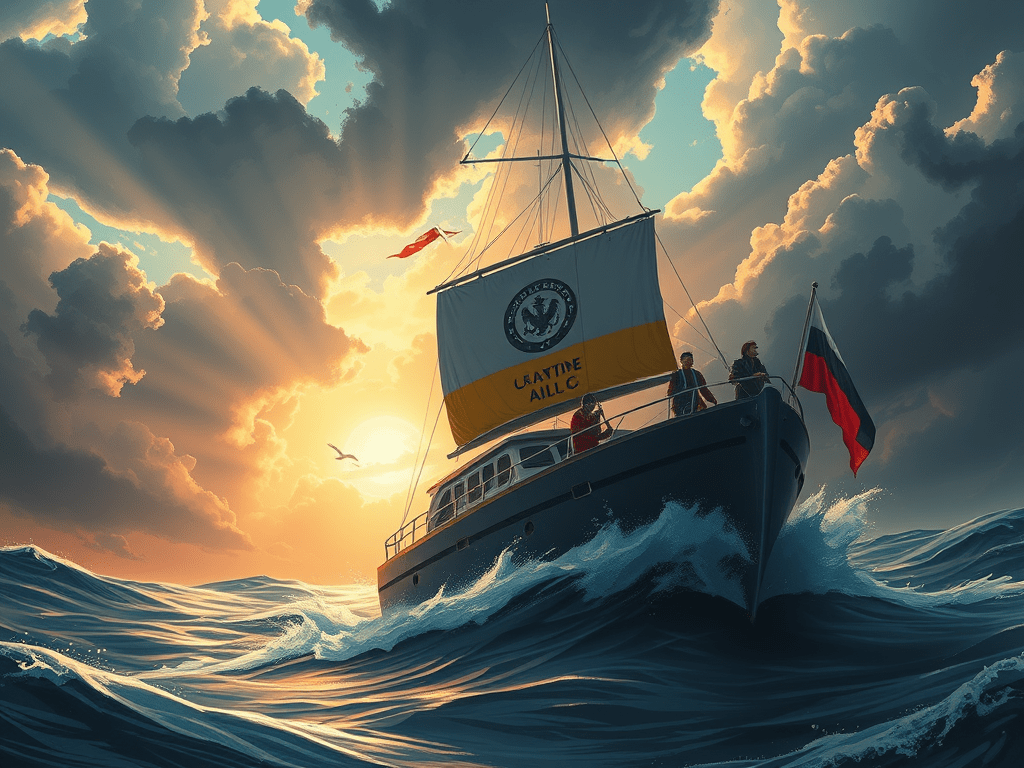
The news that an activist yacht bound for Gaza was intercepted invoked mixed feelings. Apart from the team of 12 activists including Greta Thunberg, the yacht was carrying a ‘symbolic amount’ of humanitarian aid. First, good on Greta for doing something. Here she is yet again, a Swedish teenager taking it on herself to try and do something about the injustices of this world. It’s a great deal more than what most of us manage to do. For me, the uncomfortable question brought to mind by the images from that yacht was – is it actually helping?
I mean, I can relate to Greta in the sense that I see a little bit of myself in her, when I was younger and angrier. I was either against things, or I was for saving them. There was a time when, as a student, I studied on weekdays and marched righteously up a hill on the weekend to protest against a windfarm, or against the damming of a wild river. I had innumerable stickers exhorting everyone to save things: rivers, dolphins, forests; or to stop them: mining, pollution, tree-felling. I wrote impassioned letters. Later, having been detained in a state institution and experienced a bit of what that can involve, my activism switched to a more humanitarian vein: I became more interested in what happens to people at the hard end of the societal systems which are supposed to be fair, protective and reasonable.
Looking back, it was a very ad hoc, piecemeal approach to activism. While I was more or less informed, in an environmental sense, on the issues I campaigned on, I moved from one righteous good cause to the next. If someone asked why I was protesting a windfarm or dam when these were renewable alternatives to more destructive means of electricity generation, my response was simply that this particular place was not the right one, and they should find somewhere else. Unlike Greta, I did not have a team with whom to moderate ideas or formulate plans – I largely acted alone, or in concert with a handful of others who shared the love of a particular hill, river or species. I was limited to a very localised area, so the chances of getting mixed up in international politics and agendas were minimal to zero. This was probably just as well.
What strikes me about Greta’s mission on the Madleen is this – how much thought did these fellow activists put into what they were doing? Contingency plans, yes. But in terms of the bigger picture? It would seem that in terms of the humanitarian aid itself, it is fair to say this was a negligible amount. In a situation as dire as that facing Gaza, is bringing a ‘symbolic’ or tokenistic amount of aid really what the people of Gaza need or want? I mean, imagine the possible response to this yacht arriving with a token amount of supplies on board, and then trying to distribute this small offering in a civil manner to thousands of starving people. Is that fair? Is it a sensible thing to try and do? And is it an ethical means of raising awareness? Thunberg mentioned solidarity and standing with the Palestinian people in an interview upon her return to Europe, the idea being that people can know they are not forgotten. Once again, a good intention, but at what potential cost? If the situation were less dire and immediate, then sailing a yacht into the harbour might well be a welcome move. But in the current situation, there is a chance it could just be irritating and even outright dangerous in potentially creating further chaos.
As far as awareness-raising goes, these kinds of strategies have a long-standing history. It comes out of the same playbook as activists chaining themselves to buildings or trees, blocking motorways to raise awareness of climate change, or otherwise doing something that causes just enough disruption or discomfort so as to draw direct attention to a problem. By this measure, we could say that the yacht voyage was at least a partial success. The Israeli response was perhaps not unexpected, nor the fact that they might in turn try and use the situation to their own advantage by showing footage of the activists being given water and sandwiches. Awareness raising has long been the rallying cry of many activist missions. But at what point does that need to switch to something else? Awareness is critical in the sense that people have to be aware that something is a problem before anything can be done about it. But once that much has been achieved, there arguably needs to be some kind of Action 2.0 upon which to draw. The risk with too much awareness raising is that it actually does the opposite of what it intends to: that we tune out knowing there is little chance of having any measurable impact on the outcome.
Greta suggests the world needs more angry young women. Certainly, the media has picked up on one angry young woman and made sure that her activism is highlighted. The average angry young-woman-activist is probably still more likely to be shut down, excluded, maligned or ignored. Whether it’s helpful to encourage more people down that path as individuals is debatable, unless it is as part of a more coherent, cohesive movement with backing behind them. The yacht voyage is the type of activism that is high-profile, headline generating, and somewhat sensational. What it achieves in real terms is hard to know. There is the potential for people to be turned away by what could be deemed a publicity stunt-move. A thoughtful, coordinated approach to activism might see these kinds of tactics replaced by something more unifying and less attention-grabbing.
Image & Title Credit: AI
-
Rethinking Priorities: Need, Want or Wastefulness?
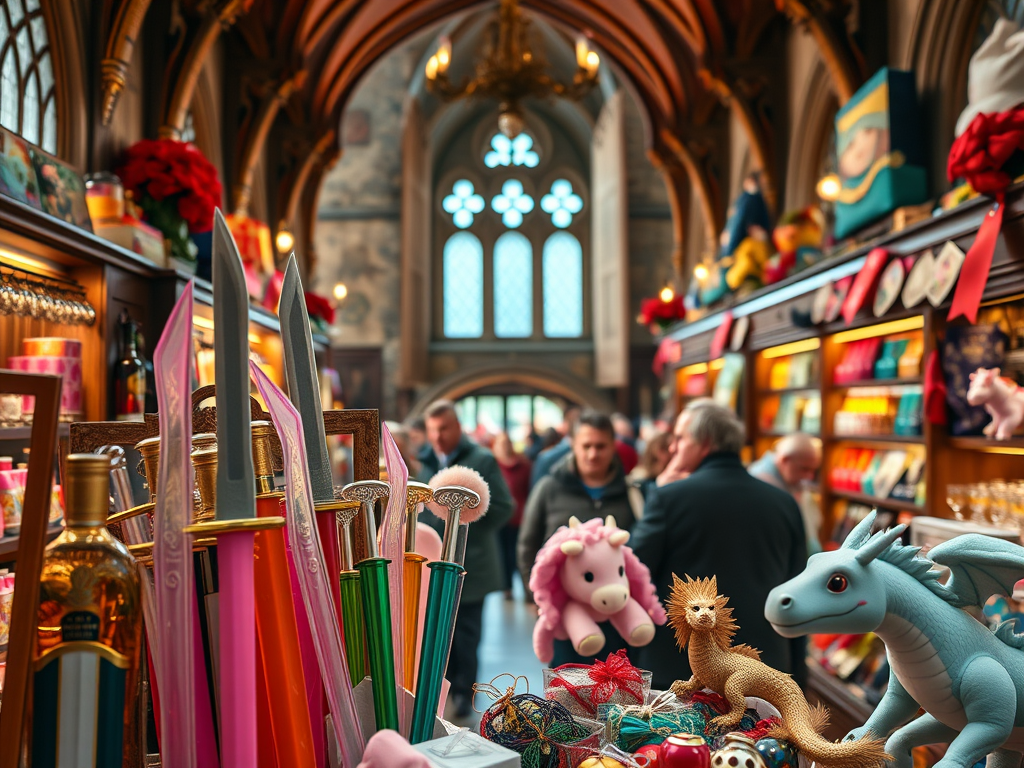
Plastic toy swords, pink unicorns, and a bowl full of squishy dragons were the culprits in a castle gift shop. What they did was hard to describe. It was hard to know where any of this rightly began and ended, or where the sense in it was. But what was clear was that something was out of balance here, and it didn’t feel right. There was something “off” about all of this. Some other kind of dragon was in the process of being created. And it was the mixed-up priorities that were bringing it to life. While some starve, others buy dragons.
The unicorns are sold in a gift shop on the banks of a highland loch. They are sold alongside a range of fine whiskies, shortbread, and chocolates. You can also find tweed dog coats, luxurious cashmere scarves, golf kit, and key rings – you name it. This is the essence of the modern castle experience. It includes a wander about the grounds and a short film outlining a noble history of warrior clans and chiefs. This is followed by the buying of luxury items or tacky toys made cheaply on a foreign continent. What does it all mean?
For one thing, it has created a market. There is a market for tourists to come to this place. There is a market for rental accommodation. There is also a market for selling gifts: some are high-end and luxurious; others are cheap and nasty. But all are at marked-up prices. And people come. Hundreds of them. The roads buzz with traffic. Carparks are at a premium. The castle grounds stream with a river of people of all nationalities. Accommodation has become unaffordable for those working to sell the plastic dragons and unicorns and luxury goods to the tourists.
Over in China, someone is making plastic dragons. When I say making, churning them out on a factory production line is probably closer to the truth. And likely for meagre wages. Right here, there is also employment. There are jobs in manning carparks and selling souvenirs. This great array of jobs keeps a large number of people employed. The reason or purpose behind any of this work is less clear. Is this really what people want? This great circle of consumption, resource use, cheap labour and inequality? A job serving tourists hardly offers a secure existence. Tourists have vastly superior spending power. The wages of those who work for them are modest.
At the same time, humanitarian organisations encourage us to donate our spare cash so that children in Gaza can eat. They use messages like: “Nearly every humanitarian response is critically underfunded. Every cent counts, and saves lives. Contribute today!” Every cent counts. Try telling that to a tourist seeking pleasant experiences, buying whisky or a tacky plastic dragon for their child. “Look here. You are on holiday buying gifts for those you love so much that you would give them anything in the world. Even that squishy plastic dragon. But wait…every cent counts! Contribute today! Humanitarian responses are critically underfunded, PLEASE!!
No, capitalism is too well-entrenched for a one-on-one dialogue of this kind to have any noticeable effect whatsoever. For there is still the hope that once there is peace, once everyone has enough to eat and can go to school, then we can all aspire to live like this. We can go on holidays and buy luxury items or tourist junk. We can stay in fancy hotels and stream through historic sites in vast numbers, saying how lovely it all is. We call this the free market. We even call it democracy.
As long as this system is maintained, there will be inequality. There will be those who go without. There will be those who do it hard. Everyone is expected to earn a living with no real regard for the starting lines or the differences in wealth. The inequalities that exist are vast, and a few cents here and there towards humanitarian campaigns won’t fix it. The real dragon continues to grow. The destruction and misery it creates should not be underestimated.
Then there are the people in suits giving lectures on humanitarian action. They are far removed from the action. Some go on the occasional foray to the frontline. But their reality is not the daily experience of those they aspire to serve. They make a career for themselves. They occupy or carve out a niche where their own upkeep is maintained and paid for. We can hardly blame them. Everyone needs income, whether they clean toilets or choose to wear a suit. But all anyone really needs is some food and a basic place to live.
A potential solution lies in the radical re-thinking of priorities. What is it that we actually need? Like the people humanitarians seek to help, what basics do we need for the next day? What about the next week, month, and year? It’s not too complicated: water, food, clothing, shelter – Maslow’s hierarchy of needs again. We don’t need paintings, antiques or objects de art. We don’t need hand bags or fashion accessories. Some amount of technology is useful. Yet we don’t need most of the gadgets and junk that have flooded the market. We don’t need whisky or pink unicorns. We don’t even need holidays to faraway places.
If we all stuck to what we needed, the world would likely have more than enough resources to go round. Holiday rentals sit empty half the year, waiting for someone to spend a few nights there. They could be housing the homeless. Plastic tourist junk would no longer be made. Factories would be repurposed to make something more useful and less environmentally wasteful. Food would be eaten, not thrown away half finished. Jobs might even start to have meaning and value. Their foundation would not be creating more wealth, or pursuing ever greater growth. And the basic humanitarian standards set in places like Geneva, would be usefully viewed as all that anyone needs.
Image Credit: AI
-
Redefining Identity: Beyond Borders and Nationality
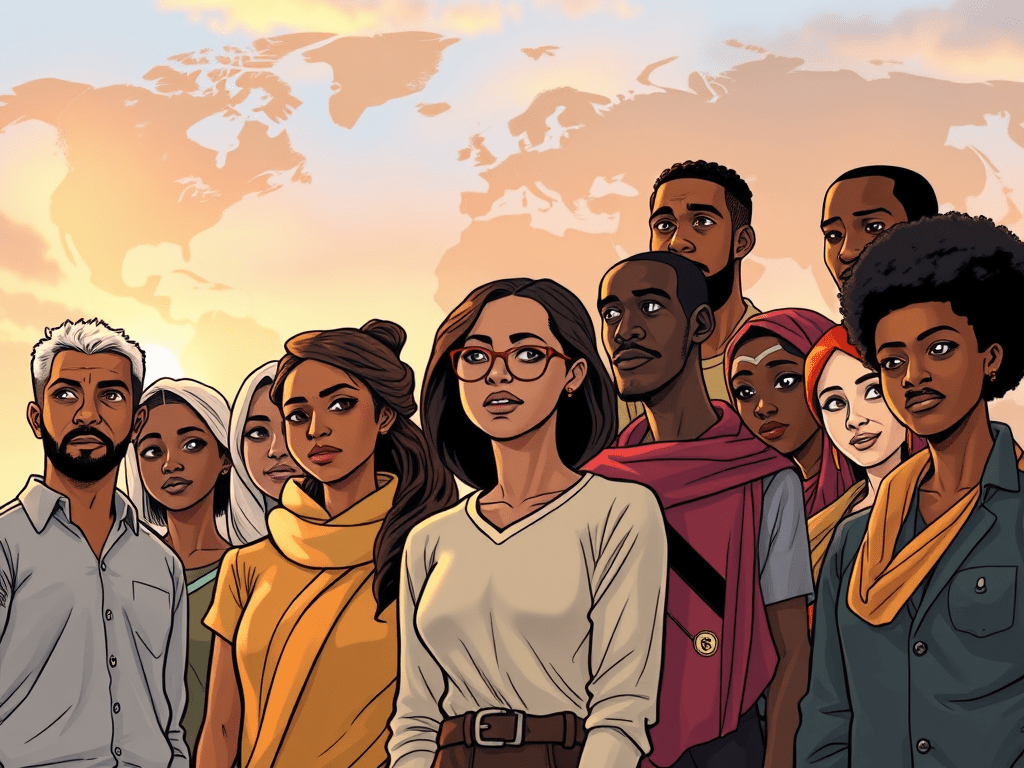
Countries are over-rated. This comes from one who was born in one, with parents of two, and raised in a third, of which they were never a citizen, with a significant family presence in a fourth – one who eventually has to admit they really aren’t from anywhere, and never were. When people say, sometimes with a great deal of pride and confidence, “I’m British”, “I’m Indian”, or “I’m Ukrainian”, a question arises. What is this, “I am…”? For some, this being from somewhere is clearly a straightforward thing. Maybe they were born and raised and hold citizenship all in the same place, which means that is ‘their country’, of which they hold the passport and can claim they are a full member. That is their history and identity. Others have mixed heritage. And for some, it can be a case of mixed heritage, plus migration, complication or just a general lack of clarity.
Countries are over-rated because they are arbitrary. Some go to great lengths explaining how their country differs from other countries; how ‘their’ people differ from those across the border. Countries are tribal. There is that sense of a nation turning towards its own; prioritising the ins over the outs; favouring the in-group like a bunch of children in a school playground. Like children, they make their rules about who can be admitted, who belongs, what they must do to become part of the in-group, and how hard or easy it should be to gain the coveted status of citizen.
I can think of one particularly arbitrary country that insists on a period of proving one’s commitment to a place that one may have called home since the age of two. The rules say that one cannot leave for more than an arbitrary number of days during the period of proving one’s ‘commitment’ to that country, and only the last five years will be taken into account. One must be of good character, and one must provide letters to prove it. Yes, they say, these are our rules and if you want to be a citizen who is welcome in our country, then you must abide by them. Never mind you thought it was your home. Or that you thought you belonged here, or that you lived here all your life: prove yourself, and then we might say you’re welcome here. Or not.
There is a difference between those who choose to migrate, and those who are moved as children. The former makes a choice; the latter are simply passive ‘baggage’ as it were, with no will or choice in the matter. This makes a difference when it comes to later life and identity. Because, this whole question of where one comes from is important on some level; it matters. People ask “Where are you from?” It’s supposed to be an easy question; an icebreaker even. The answer can determine so much. But when there are no easy answers, the matter of country can be a source of pain. Every question is a reminder: nowhere. Yet, it can also be a source of strength.
Colonisation adds another dimension. In a country where the indigenous people were effectively invaded by a foreign empire, this notion of who has rights to be and to belong in a country becomes all the more interesting. If the colonising people weren’t entirely welcome, or their actions were wrongful in certain ways, should later rules be made according to their systems and ways of thinking?
“Not I, some child born in a marvellous year, Will learn the trick of standing upright here.” – Allen Curnow
Curnow’s final couplet captures a sense of colonial uncertainty. If there’s a tendency towards a collective sense of unease in colonial or migrant cultures, there’s certainly an individual unease. What right do I have? Why do I feel entitled to be here, and on what grounds? And the thought that, just maybe, I should go back to where I came from. In some ways it’s easier knowing that the soil beneath one’s feet is where one’s ancestors lived and died – endlessly, for generations of solid belonging somewhere. Before wars got in the way, or economic hardship, or any number of other reasons that drive people across oceans in search of new beginnings.
Growing up in a country where one doesn’t hold citizenship, there can be certain challenges that others are unaware of. The pain of feeling like one should belong, but knowing one doesn’t fully belong on paper. Not having equal rights. Not having the passport of that country, or passing through segregated lanes at the borders. This is the life of a permanent outsider. “No one’s saying you can’t get citizenship” may come the blithe retort when this situation is put into words. Maybe they forget that arbitrary countries have arbitrary rules. They forget the number of days that need to be counted, the number of commitments that must be proved, the filing of paperwork and paying of fees – all this to be part of their country; a country one lived in since they were a toddler.
Some people go to war for their countries. For someone who doesn’t have a country, this sentiment is hard to understand or relate to. Even when trying very hard to feel what it must be like to have this all-consuming love for one place and people on earth; a love defined by clear geographical boundaries, and for which one will fight those of other countries because “this is mine” or “it is ours”, the feeling fails to materialise in any meaningful way. For one who has no country this is a foreign concept. Boundaries are largely irrelevant.
As for maintaining a sense of personal identity, beyond a national identity, it takes a good deal of acceptance and a widening appreciation of what matters. Rather than being of a country, or even being from somewhere, a migrant’s many strands can lead to a widening sense of identity. A narrow sense of belonging to a particular place can, eventually, give way to defining oneself by values rather than a particular place, or way of life. When there is no country, it becomes necessary to adapt. It is necessary, if one is to go on and not give up, to put the whole business of country in perspective. It may even be necessary to let go of the excessive love and care for what one thought was one’s country, and transform that energy into something more global and inclusive. It is possible to realise a love for many peoples, and many places. It is even possible to feel a little patriotic, on behalf of wherever one goes.
Image and Title Credit: AI
-
Subscribe
Subscribed
Already have a WordPress.com account? Log in now.
 Fuzzy Brown Line